
Majestic Marble
Last week I took my mother to the annual Sylacauga Marble Festival located in my hometown of well, . . . Sylacauga, Alabama. It was a lovely spring day, so I loaded up the wheelchair. My sister Nancy met us at the B. B. Comer Memorial Library. Nancy rolled Mother inside, and we all enjoyed perusing the 51 marble sculptures on display. Many were from Italian sculptors at previous festivals.
Every year, one Italian sculptor is invited to the festival. Local sculptors also come, as well as others from out of state. Craigger Brown serves as Sylacauga’s resident sculptor. Nancy says the sculptors enjoy participating in the festival partly because of the area’s marble. Each sculptor is given a block of white marble to work on during the festival. It’s fun to visit the sculptor’s tent and see them in action. They love its purity and softness.

Sylacauga is especially proud of one of its own sculptors, Frank Murphy. Frank, who now resides in Georgia, is also an exquisite painter. One of his paintings hangs in the First Baptist Church foyer.
We were happy to speak with Frank. My husband Parky lived down the street from the Murphys growing up. The Murphy boys and Parky found plenty of mischief to get into.
Mother, Nancy, and I eventually landed in the artists’ room, where items were available for purchase. As a volunteer, Nancy kindly contacted me the day before to clue me in on some purchase options. She knew I wanted a piece representing Sylacauga’s namesake. I ended up buying two pieces: a beautiful cross with another cross etched inside and a triangular Celtic symbol on an easel. I enjoyed conversing with the sculptors later who made them.
So What’s the Deal About Marble?
Some of you may already know, but the city of Sylacauga is home to what some say is the “finest white marble in the world.” The marble quarry is part of the “Murphy Marble Belt” that extends 32 miles long, 1.5 miles wide, and 400 feet deep. It is considered to be the world’s largest commercial deposit of madre cream marble.
According to historical records, the first recorded discovery of marble in Sylacauga was in 1820 by Dr. Edward Gantt, a surgeon who accompanied General Andrew Jackson through the area during the Creek War of 1813-1814. By the 1830s, several quarries were developed in the county. By the early 1900s, New York bought Gantt’s Quarry in Sylacauga.
Gantt’s Quarry became a small village comprised of a company store, company schools, housing, a post office, and several churches. Not surprisingly, it was also a prime recreational spot.
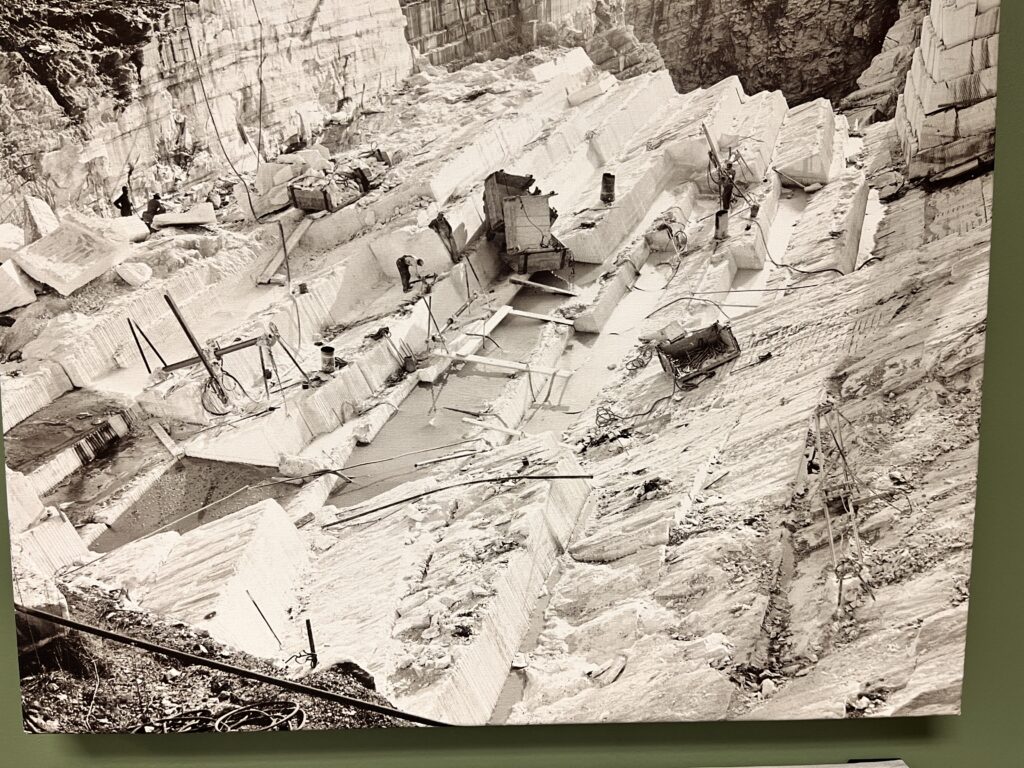
In 1944, the quarry expanded its operation to include calcium products. Ownership changed hands numerous times. Today it operates under the Imery’s Company, recognized internationally for its mineral processing. Mother and I had the privilege of touring the facilities a few years ago.
The Festival did not exist when I was growing up. However, I always felt a sense of pride about where I lived. Marble from Sylacauga is found in prestigious buildings and monuments across our nation’s capital. The United States Supreme Court boasts 36 interior columns; the Washington Monument and Lincoln Memorial also highlight the lustrous cream stone.
Biblical Significance of Marble
Marble symbolized wealth and beauty even in biblical times. Its use in temples and palaces was evidence of its value for aesthetic qualities and durability. The mention of marble in the Bible relates to divine majesty.
The first place we see marble in scripture is in 2 Chronicles 29:1-2. Here, it is mentioned among other precious materials used for the construction of the temple:

“Then King David turned to the entire assembly and said, ‘My son Solomon, whom God has clearly chosen as the next king of Israel, is still young and inexperienced. The work ahead of him is enormous, for the Temple he will build is not for mere mortals – it is for the Lord God himself. Using every resource at my command, I have gathered as much as I could for building the Temple of my God. Now there is enough gold, silver, bronze, iron, and wood, as well as great quantities of onyx, other precious stones, costly jewels, and all kinds of fine stone and marble.”
Other books that specifically mention marble are 1 Chronicles, Esther, and Song of Solomon. Solomon used marble as a poetic metaphor for strength and beauty: “His legs are as pillars of marble, set upon sockets of fine gold” (Song of Solomon 5:15). Esther describes the magnificence of King Ahasuerus’ palace with marble pillars.
The use of marble in scripture serves as a testament to the artistic and architectural achievements of ancient civilizations. Its association with divinity and royalty adds to its majestic nature.
Besides beauty and strength, white marble represents purity and is often associated with the nativity story, representing the purity of Christ’s birth.

4 Comments
Leave a Comment
Follow This Blog
Ewe R Blessed Ministries / Karen O. Allen

Rock on my friend! These are all very interesting facts about marble in the Bible!
Guess now you know a little more about Alabama that you didn’t know before.
Thank you! I have enjoyed your daily Prayer Patterns in Mission Mosaic. God bless you as you continue your ministry. My roots are in Ireland also near Donnegal.
So happy to read your comment, Cathie. Thanks for your encouraging words. That is way cool that your heritage hails from Ireland, too. I appreciate your reading my blog.